Did you know that over 90% of the world’s digital information was created in just the last two years? This huge increase in data has changed how companies work and compete today.
To stay ahead, you need to know how to use this information well. Learning Data Science & Big Data Analytics is now essential for career growth.

By getting these skills, your company can make decisions based on data. This helps you find hidden patterns and predict future trends. You’ll be able to use numbers to get a clear advantage over others.
This guide will help you on your path. We’ll cover the basics of this field before diving into the technical parts.
Key Takeaways
- Understand the massive scale of modern information growth.
- Recognize the shift toward evidence-based corporate strategies.
- Learn how to gain a competitive edge through technical mastery.
- Prepare for a structured professional development roadmap.
- Identify the core components of successful organizational intelligence.
Foundational Knowledge and Mathematical Prerequisites
Your journey into data science starts with learning the math behind it. You need a strong understanding of the math that makes algorithms work. This knowledge lets you do advanced data analysis with skill and accuracy.
Mastering Linear Algebra and Calculus
Linear algebra is like a language for data, letting you work with big datasets easily. Calculus gives you the tools to make your models better.
When you train a machine learning model, you’re trying to make it as good as it can be. Calculus helps you find the best settings by looking at how things change. This mathematical rigor keeps your models accurate and ready for real-world use.
Probability and Statistics for Data Modeling
Probability helps you understand uncertainty in data. Statistical modeling lets you make smart guesses from incomplete data. This is key for building systems that work well even when they see new data.
Knowing these math areas is the foundation of predictive analytics. It lets you guess what will happen next based on what happened before. Whether you’re classifying or predicting, good stats skills make your work better. Here’s how these math areas help you grow professionally.
| Mathematical Domain | Primary Application | Key Benefit |
|---|---|---|
| Linear Algebra | Data Representation | Efficient Computation |
| Calculus | Model Optimization | Improved Accuracy |
| Probability | Uncertainty Analysis | Risk Mitigation |
| Statistics | Predictive Analytics | Informed Decision-Making |
Using these math concepts every day changes how you do statistical modeling. As you get better, predictive analytics becomes second nature. Staying sharp in these areas is what will make you stand out in data science.
Programming Proficiency for Data Professionals
Your journey into data science starts with learning key programming languages. These tools are the base for your daily tasks in data engineering and complex analysis. Without a strong grasp of these languages, navigating the modern data landscape becomes significantly more difficult.
Python programming is the most versatile language for professionals today. Its simple syntax lets you build complex pipelines with minimal effort. It’s the industry standard for almost every data-related role.
Python Libraries for Data Manipulation
To handle large datasets effectively, you must learn powerful Python libraries. Tools like Pandas and NumPy help you clean, transform, and analyze information efficiently. These libraries turn raw data into actionable insights through streamlined code.

Mastering these libraries automates repetitive tasks, saving you hours. Efficiency is key when working with massive volumes of information. You’ll spend less time debugging and more time uncovering valuable trends.
R for Statistical Computing
While Python is a general-purpose powerhouse, R is specifically designed for statistical computing and graphics. Many researchers and analysts prefer R for its deep integration with advanced mathematical models. It provides a robust environment for testing hypotheses and visualizing complex distributions.
Use R when your primary goal involves heavy statistical analysis or academic research. Its vast collection of packages makes it a unique asset in your toolkit. Learning both Python and R will give you a significant competitive edge in the job market.
SQL and Database Management Systems
No data professional can succeed without the ability to interact with relational databases. Mastering SQL database queries is essential for retrieving and managing information stored in large-scale systems. You will use these queries to extract specific subsets of data for your models and reports.
Understanding how to write efficient SQL database queries ensures that your data retrieval processes remain fast and reliable. This skill is vital for maintaining the integrity of your data pipelines. SQL is the universal language for communicating with databases across all industries.
Developing these technical skills will solidify your role in data engineering and analytics. As you practice these languages, you will gain the confidence to tackle even the most challenging projects. Consistent application of these tools is the surest path to professional mastery.
Understanding Big Data Technologies and Ecosystems
Getting good at the big data ecosystem is key for anyone wanting to do well in data engineering. Today, companies make a lot of data, and using strong Big Data technologies is a big plus. You need to know how these tools work together to handle and store data well
Distributed Computing with Apache Spark
Apache Spark has changed how developers work with big data. It uses memory to process data fast, much faster than old disk-based systems. With Spark, you can do complex analytics, machine learning, and stream processing quickly.
Managing Data Lakes with Hadoop
Hadoop is key for handling big, messy data in one place. It’s a scalable framework that lets you store lots of data cheaply. The Hadoop Distributed File System makes sure your data is safe and easy to get to, no matter where it is.
Cloud-Based Data Warehousing Solutions
Today’s cloud computing platforms are changing how companies do analytics. These services offer flexible, on-demand setups that save you from buying expensive hardware. Moving to the cloud lets you grow your resources fast, based on what you need.
| Technology | Primary Use Case | Key Advantage |
|---|---|---|
| Apache Spark | Real-time Processing | High-speed computation |
| Apache Hadoop | Data Lake Storage | Massive scalability |
| Cloud Warehousing | Business Intelligence | On-demand flexibility |
Developing Expertise in Data Science & Big Data Analytics
You can unlock the full potential of your data by using advanced algorithmic strategies. This goes beyond just processing data. You need to apply complex models to solve big business problems. Mastering Data Science & Big Data Analytics means solving problems at a high level and implementing strategies.
Machine Learning Algorithms and Implementation
The heart of modern intelligence is in using machine learning models well. By focusing on predictive analytics, you can predict trends and find hidden patterns in big data. Choosing the right algorithm for your goal, like classification or regression, is key.
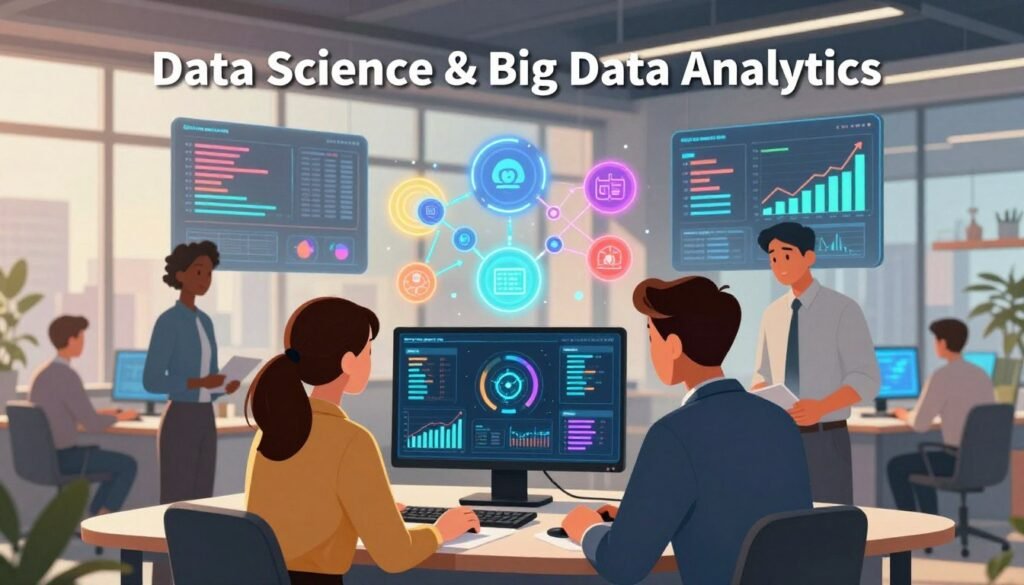
Deep learning is a big step up from old statistical methods. It uses neural networks to handle non-linear complexities in data. Knowing tools like TensorFlow or PyTorch is important for building scalable models.
These tools help you process huge amounts of data accurately. Deep learning is great when old methods don’t cut it. Learning these tools lets you work with complex data easily.
Natural Language Processing Techniques
Modern Big Data technologies need to understand human language. Natural Language Processing (NLP) helps you get insights from text, like reviews and emails. It’s key for understanding what people really mean.
Techniques like tokenization and named entity recognition help clean and analyze text. Turning raw text into structured data gives you an edge. Using NLP means you won’t miss out on any important info in your text data.
Data Visualization and Storytelling Skills
Data visualization is key to connecting technical data to executive decisions. Advanced data analysis lays the groundwork, but showing these findings visually is what sparks change. By mastering data storytelling, you make sure your insights are not just seen but understood and acted upon by leaders.

Creating Dashboards with Tableau
Tableau is a top data visualization tool for making interactive dashboards. It lets you link to many data sources and build detailed visualizations without needing to code. Its drag-and-drop interface helps highlight trends and outliers that might be missed in spreadsheets.
Good dashboards in Tableau are clear and easy to use. By organizing your metrics well, you help people understand the data at their own speed. This makes it easier for them to explore and supports data-driven decision making in your team.
Advanced Reporting with Power BI
Power BI is great for advanced data analysis and big reports. It works well with the Microsoft world, making it popular in companies. You can use its DAX language to make complex calculations for your reports, adding depth to your findings.
The platform is good at making sure data flows smoothly from databases to reports. With scheduled refreshes, your stakeholders always get the latest info. This keeps their trust in your analysis.
Communicating Insights to Stakeholders
Turning technical results into a story is the last step in analysis. You need to explain why your findings matter. A strong data storytelling approach links your visuals to the company’s goals.
When talking to non-technical people, avoid too much technical talk. Focus on what actions can be taken based on your analysis. This makes it clear how your work supports data-driven decision making in the company.
| Feature | Tableau | Power BI | Best Use Case |
|---|---|---|---|
| Ease of Use | High | Medium | Quick Prototyping |
| Integration | Broad | Microsoft-Centric | Enterprise Ecosystems |
| Visualization | Highly Flexible | Standardized | Custom Reporting |
| Cost | Premium | Cost-Effective | Budget-Conscious Teams |
Practical Application Through Real-World Projects
Turning theory into action needs hands-on effort. Academic study gives the basics, but portfolio development is key to your career. You must tackle real problems to show your skills.
Building a Portfolio on GitHub
Your GitHub profile is like a resume for employers. It shows your coding skills with datasets. Make sure your README files are clear and detailed.
“The best way to learn is to do; the best way to build a career is to show what you have done.”
Choose projects that tackle real issues. Whether it’s a predictive model or a data pipeline, show your technical skills. Regular updates to your GitHub show you’re always improving.
Participating in Kaggle Competitions
Kaggle is a place to test your skills against others. You’ll work with messy data under tight deadlines. This teaches you to work fast and use advanced modeling techniques.
Competitions speed up your learning. You can see how experts solve problems. This is great for your growth as a data scientist.
Contributing to Open Source Data Projects
Working on open source projects is valuable. You learn about version control and teamwork. It shows you can work well in a big team.
Find projects you like and help out on GitHub. Even small contributions can help your career. These experiences make you stand out in a job search.
Navigating Data Ethics and Governance
Modern data handling needs a strong focus on data ethics. As you grow in your career, knowing how to use data responsibly is as important as technical skills. Strong data governance frameworks help your team stay on the right path while using big data.
Ensuring Data Privacy and Compliance
Keeping user data safe is crucial in today’s digital world. You need to know about laws like GDPR and CCPA. Compliance is not just a legal hurdle; it builds trust with your audience.
Collect only the data you really need. Use strict access controls and encryption to protect sensitive info. Treating privacy as a key principle keeps your users and your company safe.
Mitigating Bias in Algorithmic Models
When creating machine learning models, fairness is key. Bias can sneak in if your training data is biased or lacks diversity. Always check your data for these issues before using it.
Being open about how your models work is important. Regular testing for disparate impact ensures fairness. Keeping your algorithms neutral is crucial for your work’s integrity.
Establishing Data Quality Standards
Good insights come from accurate and consistent data. Clear data governance frameworks help keep your data reliable. Without these, even the best machine learning models can fail.
Use automated checks to find errors early. Clean, well-documented data makes your analysis reliable. Consistency is the key to turning raw data into useful insights.